The One App That Unlocks China
Payments, Transport, Food and More: A Digital Guide


My Wednesday afternoon was interrupted by a message from Perth.
A friend heading to China— Malaysian-born, Chinese-speaking, seasoned traveler — was overwhelmed. A dozen conflicting blogs, each recommending a different stack of apps to navigate China's digital landscape. "Which one should I actually get?" she asked.
She isn't alone.
Even for those who read official documents in the native tongue, China's digital ecosystem moves faster than most travel advice. The English-speaking web remains largely a graveyard of outdated guidance — which makes arriving feel more complicated than it needs to be.
After three weeks and ten cities, I found that the answer was simpler than the forums suggest: you need one app. Everything else is negotiable.
That app is Alipay.
Why Alipay alone is (almost) enough
Alipay and WeChat Pay are China's two dominant e-payment platforms — and the ones most frequently recommended to tourists.
When it comes to transactions, they are broadly equivalent. The difference is orientation.
Alipay has positioned itself as the more internationally-focused platform. Its multi-language interface is more navigable and straightforward for those unfamiliar with Chinese app design, and it doesn't require you to find your way around a social messaging app (as is the case with WeChat) to reach the payment functions.
For a visitor arriving without existing Chinese digital infrastructure, it requires slightly less mental jujitsu.
On my 21-day circuit, I encountered two moments where Alipay fell short: both involved WeChat mini-programs.
The first was a restaurant queuing system that ran exclusively inside WeChat; I opened WeChat briefly for that step, then paid through Alipay as normal. The second was a shuttle bus booking interface; in the end, the vendor accepted an Alipay transfer to her personal account as a workaround.
Two minor detours in three weeks of otherwise uninterrupted travel.
What Alipay actually handles
Payments — everywhere. From a high-end gallery in Shanghai to a street-side jianbing (fried pancake) stall, the mechanic is identical: scan their QR code, or present yours.
If the merchant's display is visible, you scan them. Otherwise they scan you.
The Cash Paradox
By law, face-to-face businesses must be able to accept cash. De facto, the street economy has left it behind.
While international hotels, major supermarkets, and state sites will process banknotes without issue, independent boutiques and neighborhood noodle joints might simply claim they have "no change." Carrying a small reserve of paper RMB is a sensible backup, but a truly frictionless experience requires a digital reset.
Rail tickets — entirely paperless. I booked high-speed rail across more than ten cities without handling a single physical ticket. Select your seat, pay, and your passport becomes your boarding pass at the gate.
One practical note: most automated scanners are calibrated for Chinese ID cards. Use the staffed machines at the far end of the gate — they read passports, and the staff are well-practiced at helping foreign travelers through.

Public transit — one interface, every city. Under the Transport tab, Alipay generates city-specific QR codes for metros and buses. Moving between cities, simply switch the location in the menu and the app walks you through setup in under a minute.
No more accumulating transit cards with stranded balances. Or learning a new ticketing system in every new city.
Across considerable travel in many countries, I have not encountered anything that handles this as cleanly.

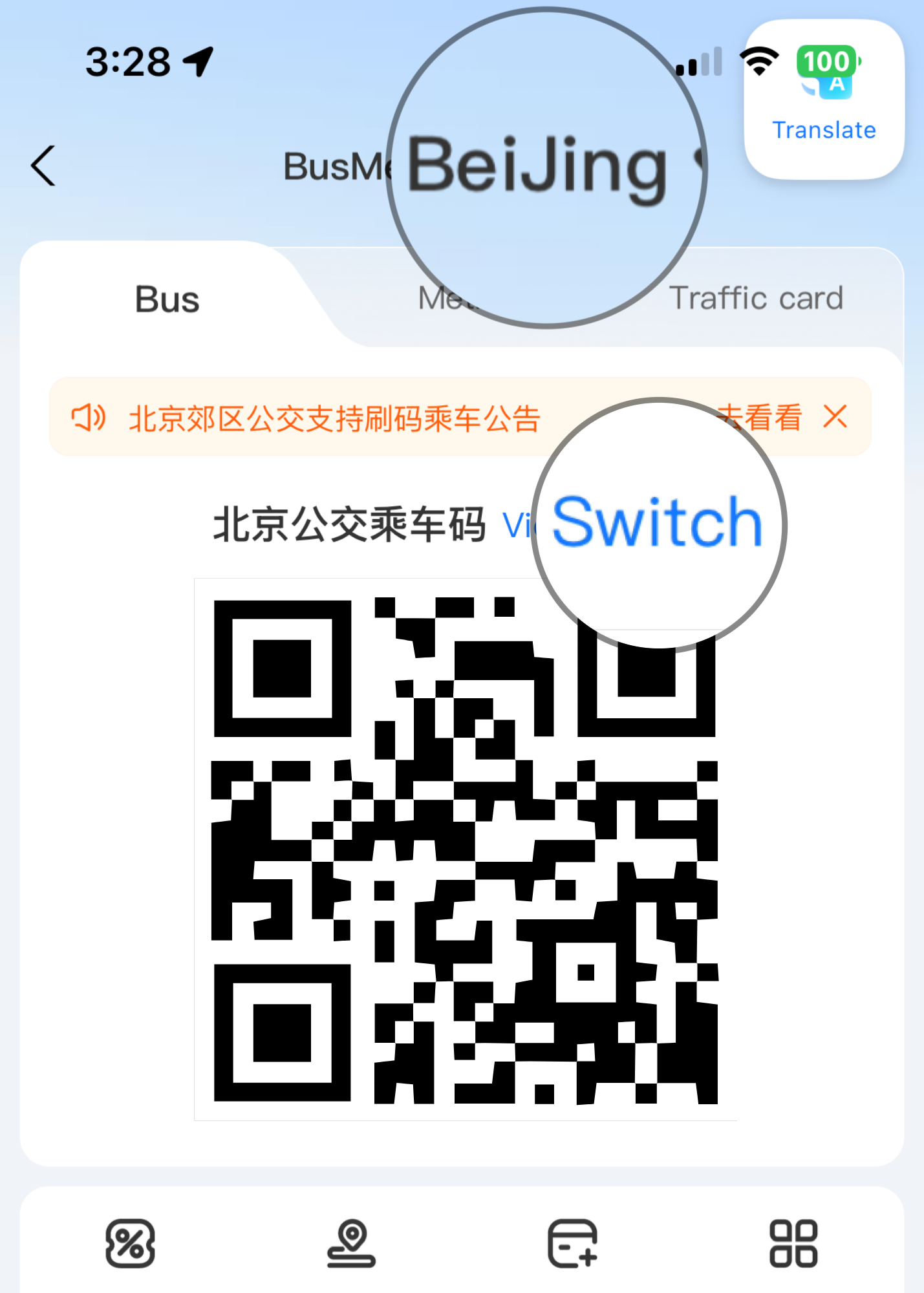
Network integration: switching between different cities and transit modes via Alipay is straightforward and seamless.
Rides — via Didi. China's answer to Uber also sits inside Alipay.
The app supports English input, but a useful habit: keep your destination's Chinese characters ready to paste in.
Occasionally a romanised address won't map cleanly to its Chinese equivalent — having the characters on hand lets you confirm you're headed to the right place before the car moves.
Connectivity — without the airport kiosk. Alipay's marketplace sells travel eSIMs directly. Specs varies by vendor, so read the product description before purchasing.
Most tourist eSIMs require no real- name registration— a standard regulatory practice in China. Those that do will say so explicitly under product listings, asking for a passport upload via a designated portal. The key advantage: these profiles route data through international servers, meaning Google Maps, WhatsApp, and Gmail generally work without a VPN.
There are limitations. Without a local Chinese +86 number, voice calls via the cellular network aren't possible, and SMS-dependent services (e.g. app registrations that require a security code) remain out of reach. For those, a physical SIM from China Mobile or China Unicom is required.
For most visitors, the eSIM is sufficient. Vendor support is usually handled via email and tends to be prompt.
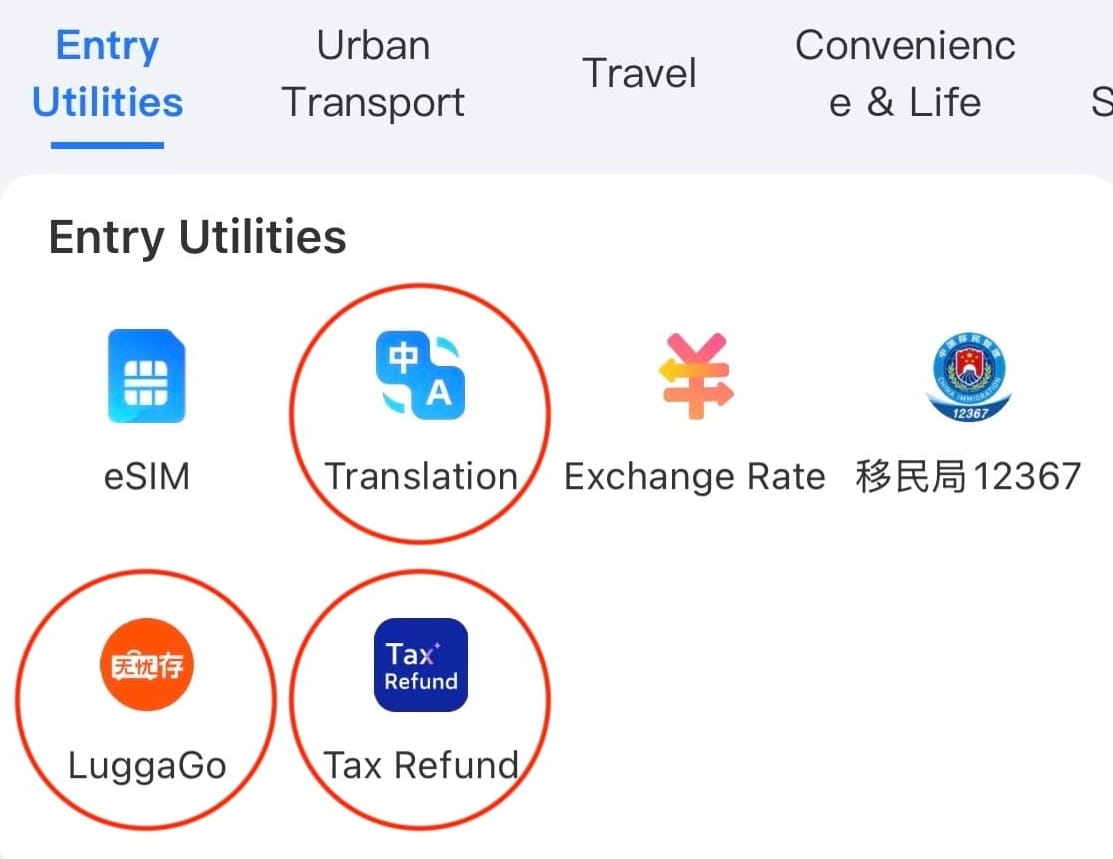
Beyond the basics The app's Entry Utilities section — found via the More button on the homepage — extends its usefulness further than most visitors realise.
Tourist tax refund portals. Luggage forwarding services that let you send bags ahead to your next destination while you travel unencumbered.
The translation tool comes with a built-in menu translation function. The real depth of Chinese regional cuisine is found by moving beyond the primary megacities. It is where the food culture is richest, but also where English menus are predictably sparse. Handy on the road.
The verdict
You will encounter advice recommending a dual-app or multi-app strategy for China. For a short trip, that is unnecessary complexity. China's digital infrastructure is not the obstacle it is frequently described as — it is, in several respects, more coherent than what you will find in most Western cities.
It is practical to download WeChat as a secondary tool, if only to handle the occasional mini-program requirement. But for the vast majority of your daily transactions, Alipay serves as a softer entry point into the domestic digital ecosystem.
Download before you land. Set it up and confirm your card connects while you are still on home ground.
Once you step off the plane, the interface will prove entirely intuitive. After that, the logistics largely take care of themselves.
-Mandarin Unpeeled



![[Quiz] Find the China City for How You Actually Want to Travel Right Now.](https://storage.ghost.io/c/73/63/7363a138-5ebf-4ec5-bfdf-0956583c3258/content/images/size/w600/2026/09/Image-Sep-2--2026-at-03_59_42-PM.png)