Datong
A city carved between cliffs and volcanoes
Datong sits at the narrow throat where China's farming heartland meets the steppe — inner Mongolia to its north, Hebei to its east, 380km from Beijing, historically the lock on the northern gate that kept invaders out and the capital safe. Before the Qing dynasty, no famous general was ever spared from a posting here.
What makes Datong genuinely unlike anywhere else is that it holds two things that shouldn't belong together in the same place: Buddhist grottoes carved by imperial order into a cliff face, and China's only volcano cluster grown out of the Loess Plateau. One city, one hand on the height of Buddhist art's arrival in China, the other on a landscape shaped by eruptions a million years old.
- THE EXPERIENCE
- The Yungang Grottoes (云冈石窟) sit 16km west of the city, first carved in 460 CE — China's first large-scale grotto project commissioned by an imperial court. Their origin has an exact historical trigger: the monk Tanyao petitioned the newly enthroned Emperor Wencheng to carve five caves into the cliff west of the capital, each housing a Buddha modelled on one of the Northern Wei's five emperors. It's the first time Buddhism's arrival in China was fused directly with state power. Look closely and you'll see a visible shift from Central Asian features in the earliest caves to distinctly Chinese aesthetics by the latest — the same stylistic evolution Longmen's grottoes in Luoyang would later inherit and continue.
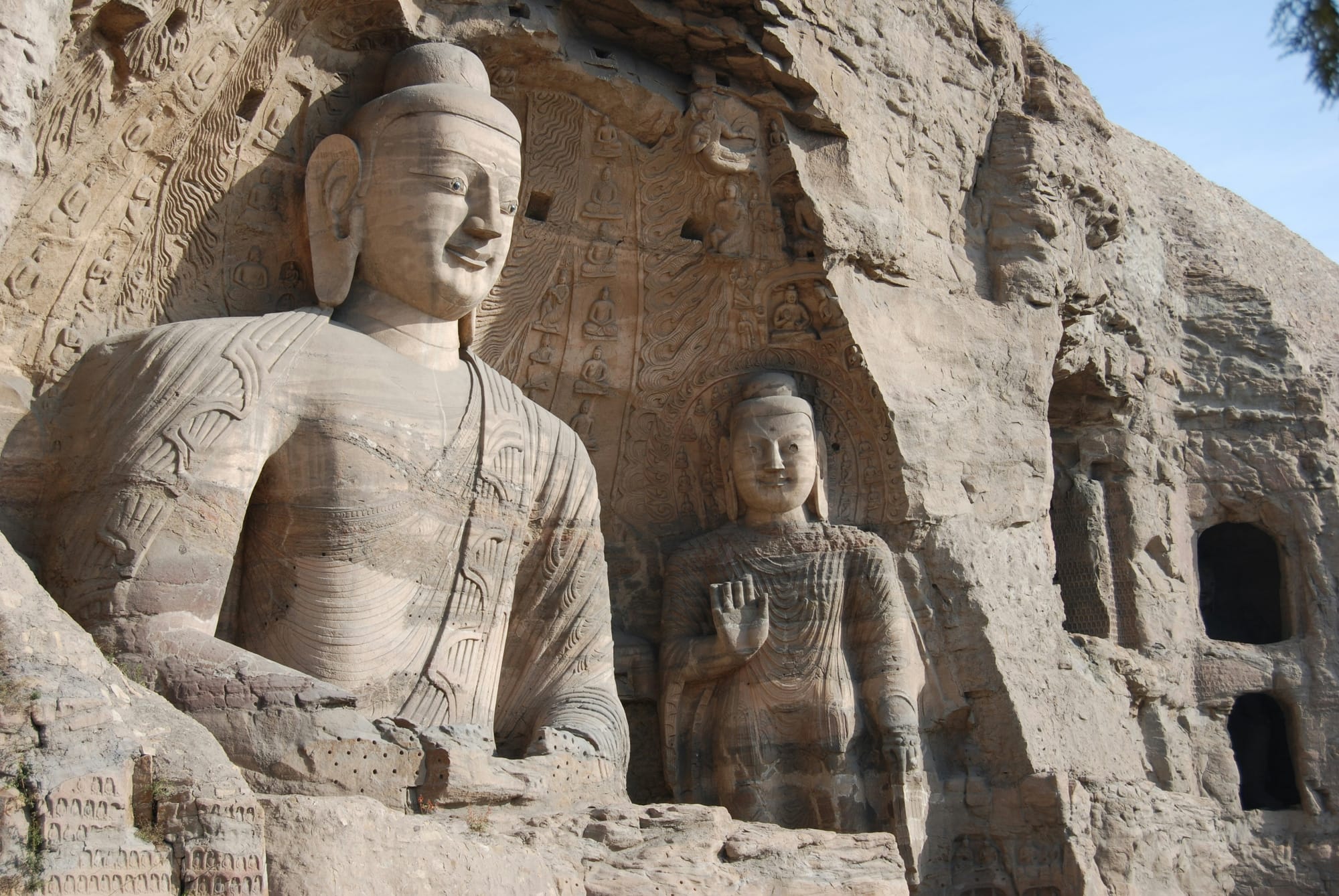
See also: Longmen Grottoes (for imperial grandeur), Mogao Grottoes (Desert Frescoes & millennia of mural art), Tianlongshan Grottoes (Refined elegance)
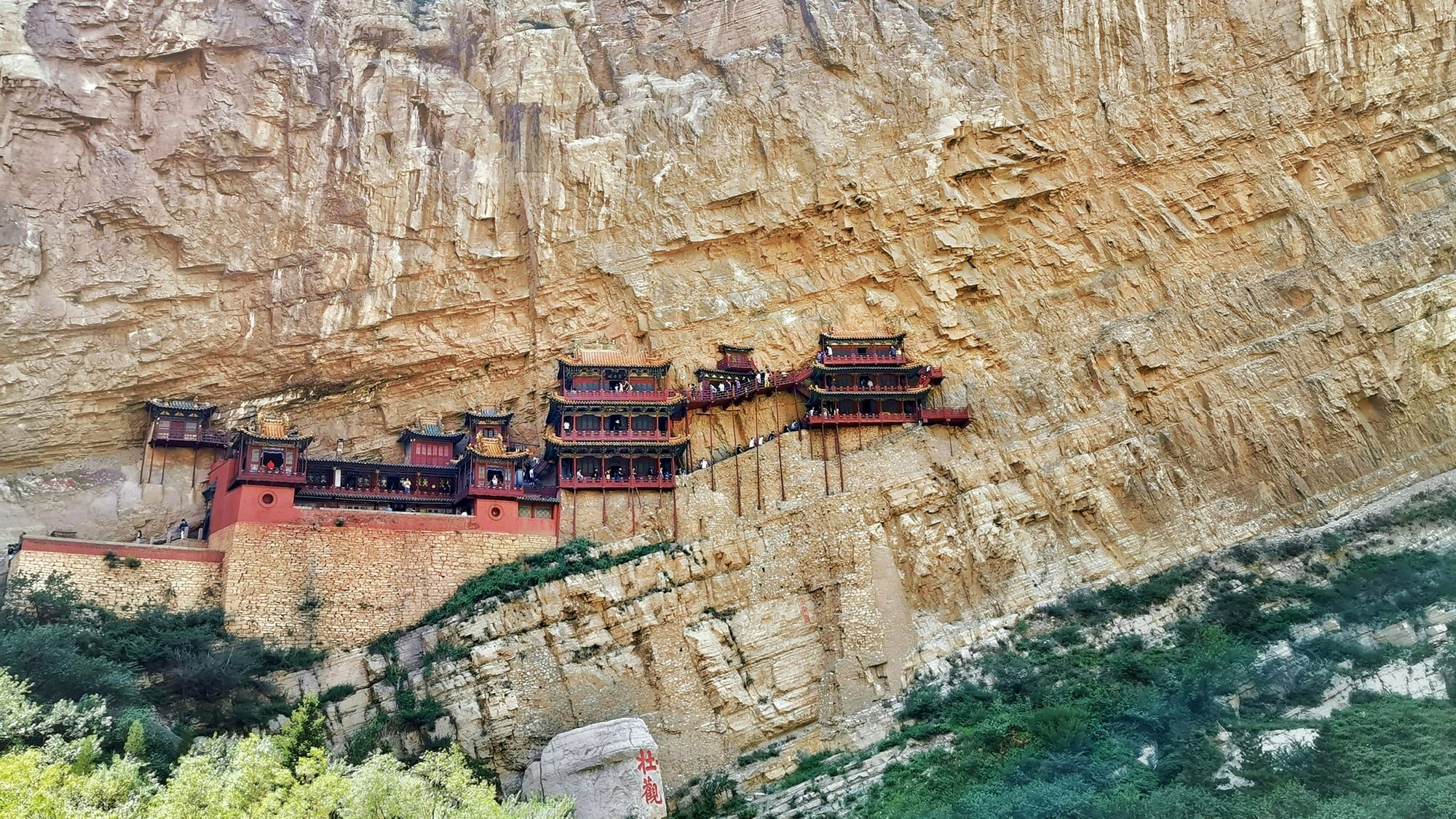
2. The Hanging Temple is the other set piece: built into a sheer cliff face in the Northern Wei (386- 535 CE) era, one of China's only temples combining Buddhism, Daoism and Confucianism under one roof. It isn't hanging for effect — the whole structure is anchored by fir beams driven two-thirds of their length into the rock, wedged and self-locking, built entirely without a single nail. The narrow walkways run barely wide enough for one person, so it's not for anyone uneasy with heights.
- Huayan Temple (华严寺) and Shanhua Temple (善化寺) are living examples of Liao (907–1125 CE) and Jin (1115–1234 CE) dynasty wooden architecture — a different register from Yungang's Buddhist-era carving. Huayan's sutra hall, built in 1038, holds a wall of Liao dynasty scripture cabinets the architectural historian Liang Sicheng once called 'unmatched anywhere in China'.
- The Ming-dynasty (1368 to 1644 CE) city wall, rebuilt by general Xu Da in 1372, runs 7.2km around the old city and has been free to enter since mid-2026. Rent a bike and ride the loop in about three hours on flat ground, or just walk the northern stretch to Qian Tower for the best view over the old town's rooftops.
- BEST FOR
Buddhist art and grotto carving draw you in, not just as a checklist item. Original Liao and Jin-dynasty wooden buildings, the real thing rather than a later reconstruction.
Northern Chinese food — noodles, lamb, coarse grains — the way it's meant to be done. An ancient capital, without Xi'an or Luoyang's crowds.
- MAY NOT BE FOR YOU IF
You want a fully intact "old town" to wander — much of Datong's old city has visibly been rebuilt in recent years, and the genuine historic architecture is concentrated in specific sites (the two temples, the wall itself) rather than spread across whole streets.
You're not up for some physical effort — both Yungang and the Hanging Temple take real time and stamina, and the Hanging Temple's walkways aren't for anyone uneasy with heights.
You have little interest in grotto or stone-carving art — Yungang can read as "a lot of rock" without that specific curiosity.
- HOW LONG?
2–3 days: one for Yungang Grottoes (budget 3–4 hours, with an electric cart available on-site), one for the Hanging Temple and Mount Heng (about 1.5 hours from the city, arrive early — it limits visitor numbers and books out in peak season), and a third for the old city — Huayan and Shanhua Temples in the morning, the wall by bike or on foot in the afternoon, timed to watch the sunset sink toward the volcanoes from the wall's south-western stretch.
- GETTING THERE
From Beijing North, high-speed trains reach Datong South in about 1 hour 40 minutes; from Taiyuan, about 2 hours. Datong Yungang Airport also runs flights to Beijing, Shanghai and Guangzhou.
- PAIRS WELL WITH
Beijing, under 2 hours by high-speed rail, as the obvious gateway · Taiyuan, about 2 hours, for more of Shanxi's Liao-Jin architecture · Ying County, home to the world's oldest surviving wooden pagoda, about an hour further on
Yungang Grottoes tickets run ¥120 and the site opens at 7:30am — arrive early to beat both the heat and the crowds.
The Hanging Temple, about 1.5 hours from the city, limits visitor numbers, so book ahead in peak season.
Summer here runs 10–15°C cooler than Beijing, which makes July and August the most comfortable window if you're trying to escape the heat.