Luoyang
A city of stone carvings and Tang splendour, where Buddhism first took root in China and spring arrives in a blaze of peonies.
Luoyang isn't one ancient capital — it's five, laid one on top of another. Thirteen dynasties ruled from here across more than 1,500 years, starting with the Xia — which makes Luoyang the earliest, longest-serving, and most dynastically layered capital in Chinese history. You don't need a museum diorama to understand how China's capitals evolved. It's stacked in the ground beneath this city.
Over 3,100 years of city-building and more than 1,100 years as a capital across 13 dynasties have left history stacked in layers here, much of it still standing: a fully intact city wall you can still bike around, and an emperor's army that spent over two thousand years underground before anyone knew it was there.
"If you want to know how dynasties rise and fall, look only at the city of Luoyang." — Sima Guang, 11th-century historian
- THE EXPERIENCE
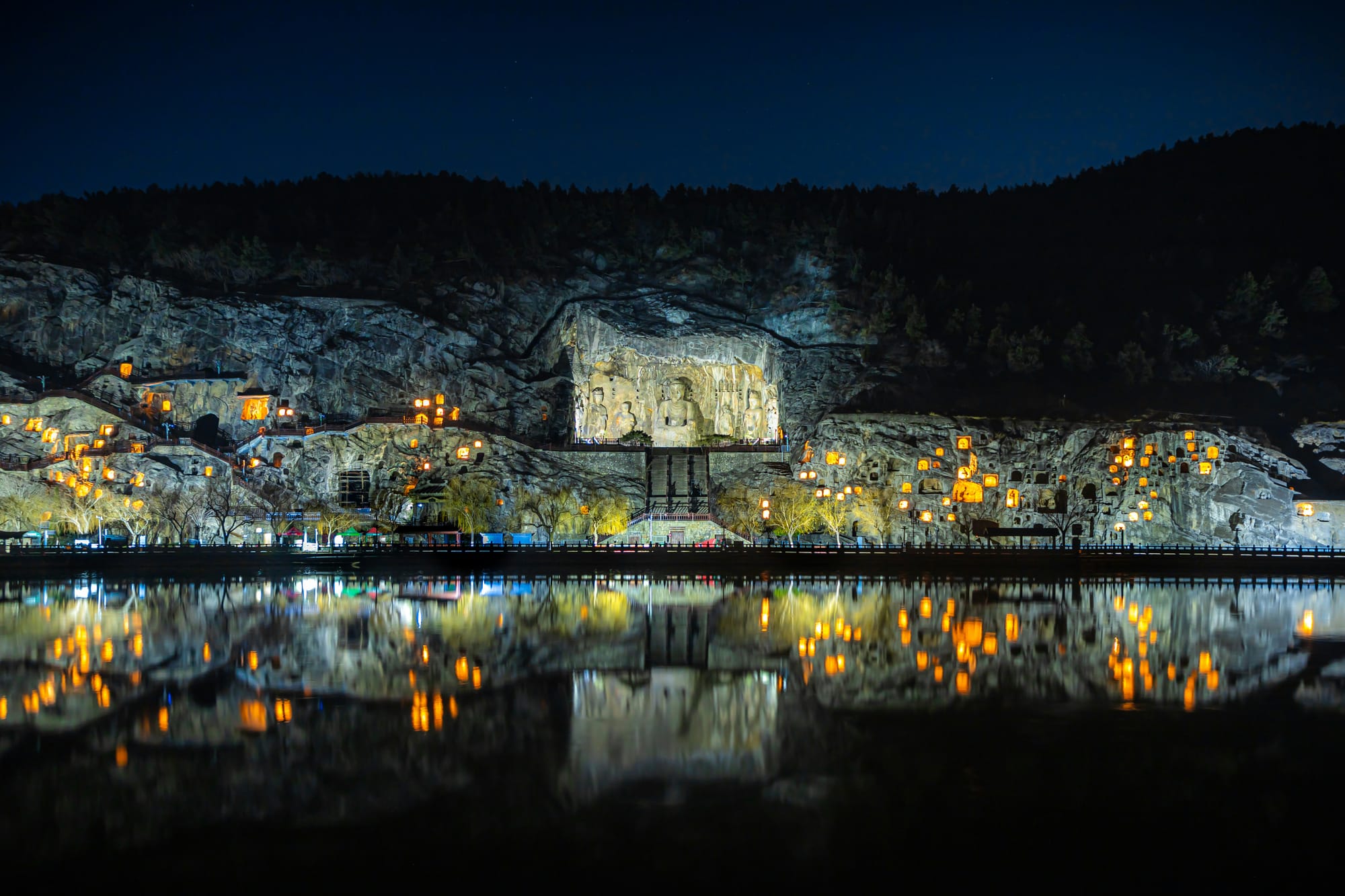
Longmen (Dragon's Gate) Grottoes is the city's major calling card: over 2,000 niches and 100,000 Buddhist carvings cut into the cliffs along the Yi River, begun around 493-494 CE and worked on continuously for the next four centuries.
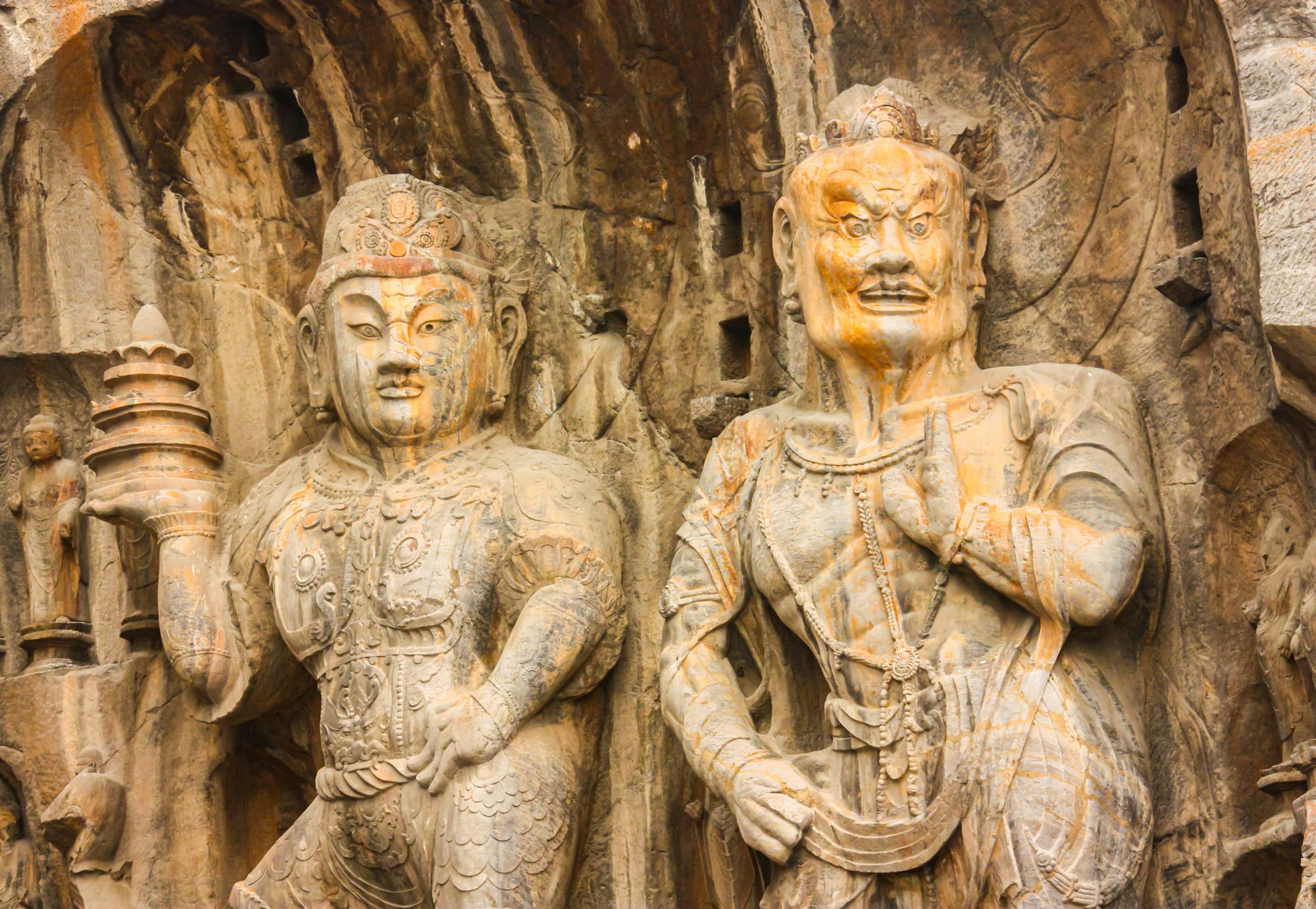
What makes Longmen different from Dunhuang or Datong's grottoes is that you can watch the style change dynasty by dynasty in the same walk — gaunt, ethereal Northern Wei (386-535 CE) figures giving way to the fuller, more confident Tang carving of the Vairocana Buddha (the cosmic Buddha of universal illumination) at Fengxian Temple (an open-air cave shrine), said to be modelled on Empress Wu Zetian (China's only female emperor, 624-705 CE) herself.
Look closely and you'll find Greek-influenced column capitals and Gandharan Buddhist motifs too — physical evidence of the Silk Road's exchange, carved straight into rock.
See also: Yungang Grottoes (for Silk Road roots, Mogao Grottoes (Desert Frescoes & millennia of mural art), Tianlongshan Grottoes (Refined elegance)
Baima (White Horse) Temple, in the city's east, was China's first official Buddhist temple, founded in 68 CE — the point where Buddhism entered China and took root. It's still an active place of worship, and its grounds now include Indian, Burmese and Thai-style halls alongside the original, so you can see several countries' interpretations of the same faith in one courtyard.
Then there's peony season. Luoyang has cultivated peonies since the Sui dynasty (581-618 CE), and the flower has been the city's official emblem since 1982. It covers the city every April, with Wangcheng Park and the Sui-Tang City ruins among the best places to see it in full bloom.
- BEST FOR
History buffs who want to see how Chinese capitals evolved. Buddhist art and stone-carving enthusiasts — Longmen rewards slow, close looking.
Travellers who want to experience northern-Chinese soup culture: beef, lamb, donkey and tofu soups define the local morning. Anyone chasing peony season in April, when the whole city turns into the display.
- MAY NOT BE FOR YOU IF
You want a single, concentrated "old town" feel — Luoyang's history lives in ruins and museums, not intact city walls or old streets the way Xi'an or Pingyao offer.
You're not drawn to Buddhist art or stone carving specifically — Longmen can read as "a lot of rock" without that interest.
You want a polished, photogenic resort city — Luoyang's urban fabric still carries its industrial-era backbone, not the curated prettiness of Lijiang or Suzhou.
- HOW LONG?
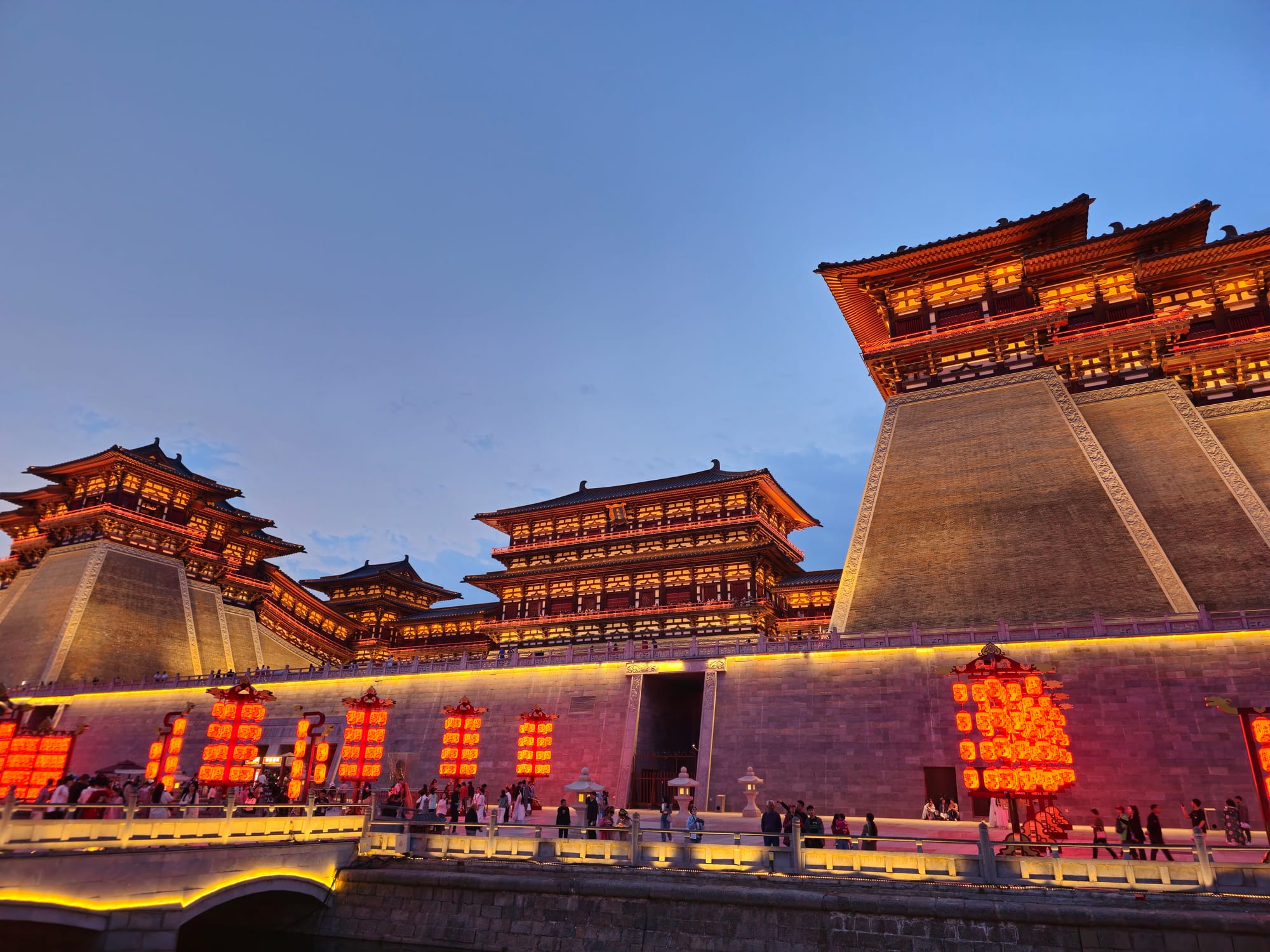
2–3 days: one for Longmen Grottoes and Baima Temple (they're at opposite ends of the city — a 40-minute drive or a seasonal shuttle bus links them, so start early). One for the Luoyang Museum (allow 3–4 hours, the Treasures Gallery on the second floor is the highlight) and the Sui-Tang City ruins — Yingtian Gate, Mingtang, and Tiantang. The gate and the two halls are best after dark, when the projection show and lighting make the scale of the Tang palace legible.
Add a day for Laojun Shan, a 2–2.5 hour drive out in Luanchuan County — a 5A-rated scenic area and UNESCO Global Geopark, its gilded bronze Daoist temples perched above a sea of clouds at 2,217 metres. It's Luoyang's most dramatic natural landscape, and worth an overnight if you want sunrise over the Golden Summit.
- GETTING THERE
The fastest high-speed trains from Xi'an take under 1.5 hours; from Beijing, roughly 4 hours. Luoyang Longmen station sits just a short taxi ride from the grottoes themselves.
- PAIRS WELL WITH
Xi'an, under 1.5 hours by high-speed rail, for more early-dynasty history along the same corridor · Zhengzhou, under an hour, where a 3,600-year-old Shang-dynasty rammed-earth wall still runs through the city centre · Kaifeng, under 30 minutes, another former capital nearby.
Longmen Grottoes entry is ¥90, with an optional ¥10 shuttle from the car park (or a 20-minute walk from the northwest service area).
Budget 3–5 hours to see it properly — a guide is genuinely worth it here, since the site's dynasty-by-dynasty stylistic shifts aren't obvious without context.
If you're chasing peonies, the bloom generally runs late March to early May, with peak flowering roughly April 7–20 — expect the highest crowds and hotel prices of the year during that window.